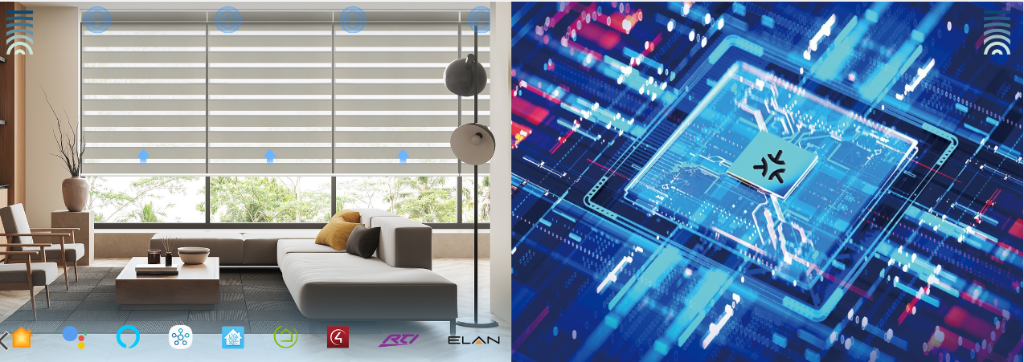
The bridge between your RF motors and the cloud. Enables app control and integration with Google Assistant, Alexa, and more via Wi-Fi.
Wi-Fi to RF+ InterfaceCloud API IntegrationUSB Powered
Eco-Friendly Power
Indoor Solar Panel (SP05)
5V | 3.4W Output
Keep your indoor shades charged with renewable energy. Features high-efficiency cells in a compact 36cm x 6cm form factor.
Outdoor Solar Panel (SP18)
18V | 4W Output
Rugged IPX5 waterproof panel for outdoor shades. Larger 47cm x 6.6cm surface area for maximum power generation.
Long-Lasting Battery Life
Our motors are engineered for efficiency. With standard use (2-3 cycles per day), our battery motors can last up to 6-12 months on a single charge.
How Motorized Blinds Work: A Complete Technical Overview
Motorized blinds combine four core systems — a motor, a power source, a wireless protocol, and a control interface — to deliver effortless, automated window coverings. Here's exactly how each piece fits together.
The Motor: The Heart of Every Smart Shade
At the core of every motorized blind is a compact tubular motor roughly the size of a marker, housed inside the roller tube or headrail. When the motor receives a command, it rotates a drive shaft that lifts, lowers, tilts, or adjusts the shade's fabric. Modern motors include:
Limit switches — programmed upper and lower stop positions to prevent over-rotation.
Soft-start / soft-stop — gradual acceleration and deceleration for whisper-quiet, gentle movement.
Obstacle detection — automatic stop if the shade encounters resistance, protecting people, pets, and the motor itself.
Adjustable torque (0.8–6 Nm) — sized to the shade's weight and width to ensure reliable operation across small windows or 10-foot wide picture windows.
The Wireless Signal Path
When you tap a button in the app or speak to Alexa, the command travels through this path:
Your input — voice command, app tap, remote button, schedule, or sensor trigger.
Smart hub or cloud — Amazon Echo, Google Home, Apple HomePod, or the manufacturer's cloud receives and validates the request.
Bridge / gateway — translates the command from Wi-Fi/cloud into the motor's native RF protocol (Zigbee, Z-Wave, Thread, or proprietary 433 MHz).
Motor receiver — accepts the encrypted command, verifies pairing, and engages the motor.
Mechanical movement — the drive shaft rotates and the shade reaches the new position.
Total round-trip latency for local protocols (Thread, Matter, Zigbee) is typically under 200 milliseconds. Cloud-only Wi-Fi shades take 1-3 seconds.
Smart Home Integration: Alexa, Google Home, and Apple HomeKit
Carolina Smart Blinds work with every major smart home platform. Here's exactly what each integration looks like, what hardware you need, and what you can do once it's set up.
Amazon Alexa Integration
Hardware required: Any Echo device with Zigbee built in (Echo Show 10, Echo 4th gen, Echo Hub) — OR — a Smart Link bridge for non-Zigbee Echos.
Setup time: 5-10 minutes via the Alexa app's "Add Device" flow.
What you can say:
• "Alexa, open the bedroom blinds."
• "Alexa, set the living room shades to 50%."
• "Alexa, close all blinds."
• "Alexa, run my Movie Night routine." (closes blinds + dims lights)
Google Home / Google Assistant Integration
Hardware required: Any Google Nest Hub, Nest Hub Max, or Google Home speaker, plus the Smart Link Wi-Fi bridge or a Matter-certified Thread border router (Nest Hub 2nd gen and later).
What you can do: Voice control via "Hey Google", schedule shades by sunrise/sunset using the Google Home app, group shades by room, and trigger automations based on presence detection or weather.
Apple HomeKit Integration
Hardware required: An Apple HomePod, HomePod mini, Apple TV 4K, or any iPad as a home hub. Our Thread-certified motors connect directly without an additional bridge on HomePod mini (2nd gen) and HomePod (2nd gen).
Why HomeKit users love Thread: Local-only commands (no internet required), end-to-end encryption, and seamless control through Siri, the Home app on iPhone/iPad/Mac/Apple Watch, and Control Center.
Matter: The Universal Standard
Matter is the unified smart home standard launched in 2022 and backed by Apple, Amazon, Google, and Samsung. A Matter-certified motorized blind works simultaneously with all major ecosystems from a single pairing — no need to choose between Alexa or HomeKit. Carolina Smart Blinds offers Matter-over-Thread motors, combining the universal standard with Thread's low-power mesh network.
Tip: If you're building a new smart home or replacing aging shades, ask for Matter-over-Thread motors. They future-proof your investment against ecosystem changes and platform lock-in.
Power Source Comparison: Battery vs. Solar vs. Hardwired
Choosing the right power source is the single biggest decision in a motorized blind project. Here's the honest comparison.
Comparison of battery, solar, and hardwired power options for motorized blinds.
Feature
Rechargeable Battery
Solar-Powered
Hardwired DC
Installation Effort
Lowest — drop-in retrofit
Low — add solar panel
Highest — requires electrician
Maintenance
Recharge every 6-12 months
Virtually none
Zero
Operating Noise
~38-44 dB
~38-44 dB
~32-38 dB (quietest)
Best Use Case
Existing homes, retrofits
Sunny windows, outdoor shades
New construction, large shades
Upfront Cost
Standard
+$50-$120 per shade (panel)
+$125-$250 per shade (wiring)
Lifespan
5-7 years (battery replaceable)
10+ years
15+ years
When to Choose Battery Power
Choose rechargeable lithium battery motors when retrofitting an existing home, when running wires would damage finished walls or trim, or when you want the simplest, fastest installation. Charge time is 4-6 hours via USB-C, and most homeowners only recharge once or twice a year.
When to Choose Solar Power
Solar is the perfect upgrade for any south- or west-facing window in Charlotte's sunny climate. The compact SP05 indoor panel (5V, 3.4W) mounts discreetly above the shade and trickle-charges the motor's battery. For outdoor zipper-track shades, the rugged SP18 panel (18V, 4W, IPX5 waterproof) handles rain and direct sun. Once installed, you'll likely never recharge the motor manually again.
When to Choose Hardwired Power
Hardwired DC motors are the gold standard for new construction, major remodels, and very large shades (over 60" wide × 84" tall). They run on continuous low-voltage power, deliver the quietest operation, and never need maintenance. The trade-off: an electrician is required during the rough-in phase, and retrofitting is rarely cost-effective.
Important: If you're remodeling or building new, ask the electrician to run low-voltage wire to every window now — even if you choose battery motors today. It future-proofs the home for hardwired upgrades later.
Wireless Protocol Deep Dive: Wi-Fi, Zigbee, Z-Wave, Thread, and Matter
Each wireless protocol has distinct strengths. The right choice depends on your existing smart home gear, the size of your home, and how much control you want.
Comparison of wireless protocols used in motorized smart blinds.
Protocol
Range
Hub Required
Mesh Network
Best For
Wi-Fi
~150 ft
No
No
Single shades, small homes
Zigbee
~75 ft per hop
Yes
Yes
Multi-shade homes with Echo/SmartThings
Z-Wave
~100 ft per hop
Yes
Yes
Large homes, thick walls
Thread
~75 ft per hop
Border router
Yes (self-healing)
HomeKit, Matter, future-proof setups
Matter
Varies by transport
Matter controller
Over Thread/Wi-Fi
Universal cross-platform compatibility
For most Charlotte NC homes, we recommend Matter-over-Thread motors paired with a HomePod mini, Echo 4th gen, or Nest Hub 2nd gen as the Thread border router. This combination delivers local-only control, fastest response times, ecosystem flexibility, and the strongest long-term compatibility.
Ready to Smarten Your Home?
Experience the perfect blend of technology and design. Schedule a consultation to see our smart blinds in action.